RSS

Tag Archives: ΤΕΧΝΕΣ: ΦΩΤΟΓΡΑΦΙΑ

Image

Φωτό: Emil Brunner (1908–1996)

Φωτό: Emil Brunner (1908–1996)

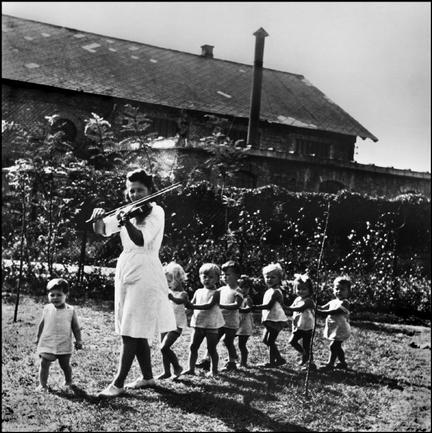
Trun, Sedrun, Rabius and Vals are some of twelve Swiss villages where Brunner took portraits of young inhabitants in 1943-44. The youngest generation of an entire society living in relative seclusion during the war years is thus brought to life. The children, from toddlers to teenagers, all stare straight into the photographer’s lens, some in anticipation and others more serious, simply happy or a bit naughty. The expressions on their faces are touching.


Tags: , ,

Image

Φωτό: Emil Brunner (1908–1996)

Φωτό: Emil Brunner (1908–1996)

In 1996 archives of photographs of considerable size by press photographer Emil Brunner were discovered in a Swiss chalet. The archives consisted of over 1700 portraits of children, of which Kunsthal Rotterdam will present a broad selection. The photographs, in black and white, which include vintage prints as well, have been taken in the area of Bündner Oberlands in 1943-44. A complete generation from this mountainous area uninhibitedly looks into Brunner’s camera. These young faces, seemingly amiable as they are, reflect rural life in Swiss mountainous villages during the war years.


Tags: , ,

Image

Φωτό: Chim (David Seymour) (1911-1956)

seymour05

1948 – l’UNESCO lui demande d’effectuer une vaste enquete photographique sur
l’enfance dans l’Europe d’apres guerre et il voyage dans toute l’Europe.Techecoslovaquie,Pologne,Hongrie,Allemagne,Grece,Italie. Puis il va
photographie la guerre d’Independence en Israel.LIFE magazine publie dans son
numero du date 27 dec.1948 pour Noel, son reportage photographique sur « Les
Enfants d’Europe ».

SEYMOUR PAR168278


Tags: , ,

Image

Φωτό: Chim (David Seymour) (1911-1956)

Φωτό: Chim (David Seymour)  (1911-1956)

MON AMI CHIM

Chim, comme Capa, était Parisien de Montparnasse. Il avait l’intelligence d’un joueur
d’échecs ; avec son allure de prof de maths il appliquait à bien des domaines sa
vaste curiosité et sa culture. Nous étions amis depuis 1933. La sureté de son esprit
critique était vite devenue indispensable a son entourage. La photographie était
pour lui un pion qu’il déplaçait sur le damier de son intelligence méticuleuse. Mais
un de ses pions de réserve était sa délicatesse gastronomique qu’il maniait d’une
manière doucement autoritaire en commandant les bons vins et les plats cuisinés. Il
avait une élégance ; ses cravates de soie noire. Sa clairvoyance, sa délicatesse lui
donnait souvent un sourire triste, parfois désabusé, qui s’épanouissait lorsqu’on le
cajolait. Il donnait et réclamait beaucoup de chaleur humaine. Il avant tant d’amis
partout ; il état ne parrain. Lorsque je suis venu annoncer sa mort à son ami David
Schoenbrun, dans la conversation qui suivit, il me dit : « Vous et moi, nous nous
connaissions peu. Et pourtant Chim était notre ami commun. Mais Chim était un
monsieur a tiroir et il oubliait de les faire communiquer entre eux. Il acceptait les
servitudes de son métier et dans des situations qui semblaient si étrangères à son
personnage, il se dévoilait courageux. Chim tirait son appareil photographique
comme le médecin son stéthoscope de sa trousse, apportant son diagnostic sur
l’état du cœur : le sien était vulnérable.

Henri Cartier Bresson.


Tags: , ,

Image

Φωτό: Chim (David Seymour) (1911-1956)

Φωτό: Chim (David Seymour)  (1911-1956)

Fluent in several languages, with deep affinities for many countries and peoples, Chim was truly international. Among his many photographic essays are outstanding portraits of Bernard Berenson and Arturo Toscanini. Chim was killed by an Egyptian machine-gunner in 1956, four days after the Armistice at Suez.


Tags: , ,

Image

Φωτό: Chim (David Seymour) (1911-1956)

Φωτό: Chim (David Seymour)  (1911-1956)

His postwar series of photographs of the physically and spiritually maimed children of Europe attracted worldwide attention, was published in a book by UNESCO, and became part of the posthumous exhibit, “Chim’s Children.” The sympathetic and compassionate portraits of these small victims of war led a friend to note that to Chim, wars were an enormous crime against children.

http://unesdoc.unesco.org/images/0013/001332/133216eb.pdf


Tags: , ,

Image

Φωτό: Chim (David Seymour) (1911-1956)

395149_473606016023222_1539307934_n


At the outbreak of World War II he made his way to New York. During the war he served as a photo-interpreter with the U.S. Air Force in Europe. In 1947, Chim co-founded an international photojournalists’ cooperative with his friends Robert Capa, Henri-Cartier-Bresson, George Rodger and William Vandivert.


Tags: , ,

Image

Φωτό: Chim (David Seymour) (1911-1956)

Φωτό: Chim (David Seymour)  (1911-1956)

Chim (David Seymour), was born in Warsaw, Poland. He studied graphic arts in Leipzig, and turned to photography in 1933 while continuing his studies at the Sorbonne in Paris. He covered many important political events for leading magazines including Life, beginning with the Spanish Civil War.


Tags: , ,

Video

Brigitte Carnochan, photography

Born in Worms, Germany, in 1941, Brigitte Camochan (Bri-GEE-tah CAR-neh-ken) survived the war to immigrate to the U.S. at the age of six with her German mother and American stepfather. Living first in Wisconsin, then Texas, and finally, California, she attended San Jose State University, where she earned a B. A. in English, followed by an M.A in education from Stanford University.
In 1990, entering her 50s, she enrolled in evening photography classes at Foothill College in Los Altos, California. “I soon discovered the department was teeming with talented teachers and students.” She also took workshops from numerous well-known photographers, including Steve Kiser, John Sexton, Ruth Bernhard, Morley Baer, William Allard, Ted Orland, David Bayles, Martha Casanave, and Cole Weston. She describes photo history classes at Stanford with Joel Leivick and Jason Francisco as “pivotal,” and goes on to emphasize, “It’s important to know the past and let it inspire the future — I don’t believe creativity comes out of a vacuum.”
 

Tags: , ,

Image

Philippe Blasband, Le livre des Rabinovitch (To βιβλίο των Ραμπίνοβιτς)

II. Λέα

Το όνομά μου είναι Λέα Ραμπίνοβιτς. Πάνε χρόνια που άνθρωπος πλέον δεν αρθρώνει το βαφτιστικό μου. Εντούτοις, όταν ήμουνα μικρή, στο σπίτι του πατέρα μου, το άκουγα συχνά «Λέα! Λέα! Λέα! Λέα!» μού φώναζαν κάθε λίγο και λιγάκι, για ψήλου πήδημα κάποιες φορές. Ήμουν η Λέα, τίποτε άλλο παρά μόνο η Λέα, ένα λεπτοκαμωμένο κοριτσάκι που φόραγε φούστες ανοιχτόχρωμες, άφηνε τα μαλλιά του να πέφτουνε στο πρόσωπό, του άρεσε να τραγουδάει σκοπούς στα γίντις.

Τη στιγμή που έπαψα να είμαι κοριτσάκι, τη στιγμή που ο άντρας μου έκανε από μένα τη γυναίκα του, με βία, την ίδια στιγμή έπαψα να είμαι η Λέα κι έγινα «κυρία», έπειτα «μαμά». Όταν μιλούσαν για μένα στο Μουνσκ μ’ αποκαλούσαν επίσης «η γυναίκα του Ζαλμάν του ασίντ» ή, αργότερα, «η γυναίκα του Ζαλμάν του λωλού», και κουνούσαν το κεφάλι μ’ έναν μορφασμό όλο αηδία. Στις Βρυξέλλες, τα τελευταία χρόνια της ζωής μου, δεν υπήρξα απολύτως τίποτε άλλο παρά η «Κυρία Ραμπίνοβιτς». Εξάλλου αυτό είναι γραμμένο και στον τάφο μου, ΚΥΡΙΑ ΡΑΜΠΙΝΟΒΙΤΣ, χωρίς βαφτιστικό, γιατί τα παιδιά μου δεν γνώριζαν το βαφτιστικό μου, ποτέ δεν το ’μαθαν, πράγμα που με θλίβει, χωρίς όμως να καταφέρνω ν’ αντιδράσω. Η εξέγερσή μου είναι δολοφονημένη. Ο Ζαλμάν Ραμπίνοβιτς την κατέστρεψε. Και την πήρε ακριβώς όπως πήρε το κορμί μου. Με τη βία.

Philippe Blasband, Le livre des Rabinovitch
Mετάφραση: Ιφιγένεια Σιαφάκα

Φωτό: Brigitte Carnochan


Tags: , , , , , , , ,